
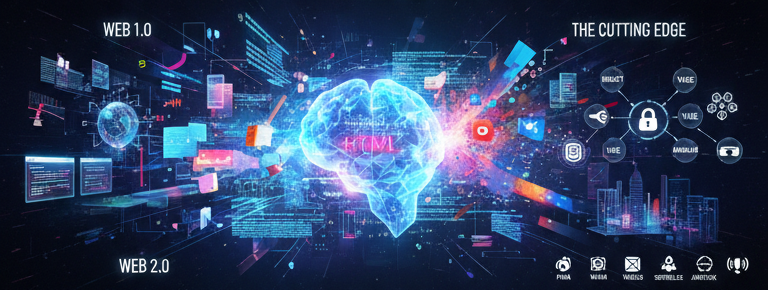
I. Intro: Beyond the Browser – What Exactly IS Web Development?
Ever wondered how your favorite websites and apps come to life? It’s not magic, it’s web development. It’s the art and science of constructing our digital reality.
Web development is more than just code; it’s the alchemy that transforms ideas into interactive experiences. It’s the invisible hand shaping how we connect, learn, and transact in the 21st century. It’s where creativity meets logic, where design dances with data, and where the user’s journey begins.
The digital world is seemingly bifurcated. On one side, there’s the shimmering frontend, the user-facing facade crafted with HTML, CSS, and JavaScript—the visual language of the web. On the other, the intricate backend, a realm of servers, databases, and APIs, where logic reigns supreme. It’s a complex ecosystem where each component plays a crucial role in delivering seamless experiences.
II. A Walk Down Memory Lane: From Static Pages to Dynamic Worlds
The web wasn’t always the sprawling digital landscape we know today. Its evolution is a fascinating tale of innovation, adaptation, and the relentless pursuit of progress.
The Dawn of the Web (Web 1.0 – Early 90s):
In the beginning, there was Tim Berners-Lee, a visionary who conjured the foundational building blocks – HTTP, HTML, and URLs. This marked the genesis of the internet. The early web was a “Read-Only” domain – static pages that resembled digital encyclopedias, offering information in a one-way flow. The “Browser Wars” raged as Netscape Navigator and Internet Explorer battled for dominance, while the introduction of CSS and JavaScript added subtle hints of style and interactivity, like the first strokes of paint on a blank canvas.
The Interactive Revolution (Web 2.0 – Mid-2000s):
Then came the shift to Web 2.0, a period of profound transformation. The web became a conversation, not just a broadcast. User-generated content exploded with the rise of social media, blogs, and wikis. Dynamic content powered by server-side languages like PHP and ASP breathed life into websites, making them responsive and adaptable. AJAX became a game-changer, enabling real-time updates without the jarring full-page reloads of the past. The launch of the iPhone in 2007 triggered the mobile revolution, forcing developers to embrace responsive design and cater to a new breed of users. JavaScript frameworks like jQuery, Angular, React, and Vue.js emerged, providing structure and efficiency to the increasingly complex world of frontend development.
III. The Cutting Edge: What’s Hot in Web Dev Right Now (Current Trends – 2025)
Today, web development is a dynamic landscape of innovation. Let’s explore the trending technologies and methodologies.
The Frontend Fashion Show:
HTML, CSS, and JavaScript remain at the core, but they’ve acquired superpowers through modern frameworks and libraries. React, Angular, and Vue.js still dominate for building complex, interactive applications. However, a new wave of rising stars—Next.js (full-stack React!), Svelte (compile, don’t ship!), Solid.js, and Qwik—are challenging the established order, offering improved performance and developer experiences.
Backend Brains & Brawn:
The backend continues to evolve, with established languages like Python (Django, Flask), Node.js (Express, NestJS, Fastify), PHP (Laravel), Java (Spring Boot), Ruby on Rails, ASP.NET Core, Go (Gin-gonic), and Elixir (Phoenix) remaining popular choices. A trend towards “API-First” development has emerged, emphasizing the importance of well-defined interfaces for seamless communication between different systems.
Beyond the Basics – Key Innovations:
- AI & ML Integration: Smart automation, personalized experiences, and AI-driven code suggestions are becoming increasingly common.
- PWAs (Progressive Web Apps): Websites that mimic the behavior of native apps, offering offline access, fast loading times, and push notifications.
- WebAssembly (Wasm): Enables high-performance code (C++, Rust) to run directly in the browser.
- Headless CMS & Jamstack: Flexible content delivery and lightning-fast static sites.
- Serverless Architecture: Developers can focus solely on writing code without the burden of server management.
- Voice Search & Immersive Experiences: Talking to websites and experiencing AR/VR content directly in the browser are becoming more prevalent.
- Cybersecurity Fortification: Zero-trust security models, MFA, biometric logins, and automated security scanning are crucial for protecting web applications.
IV. The Hurdles & Headaches: Challenges and Controversies
Despite its progress, web development faces challenges that demand careful consideration.
The Security Tightrope:
The ever-present threat of cyberattacks, data breaches, and IoT vulnerabilities keeps security at the forefront. The ethical implications of data collection and privacy require constant vigilance.
The Never-Ending Upgrade Cycle:
“Framework fatigue” and the relentless pressure to learn new technologies can be overwhelming. The shortage of developers with the necessary skills remains a significant obstacle.
Designing for Humans (and Robots!):
Balancing visually appealing UI with intuitive UX is a perpetual challenge. Ensuring cross-browser and cross-platform compatibility requires constant testing and optimization. The tradeoff between website speed and feature richness necessitates careful decision-making.
Ethical AI in a Digital Age:
Bias in algorithms, transparency, accountability, job displacement, and copyright issues all warrant careful consideration as AI becomes more integrated.
Digital Divide & Manipulation:
Ensuring accessibility for all and mitigating the potential for addictive design patterns are crucial for creating a responsible digital ecosystem.
V. Crystal Ball Gazing: The Future of Web Development
Predicting the future is never easy, but current trends point towards some exciting possibilities:
AI Takes the Driver’s Seat:
AI-first development, where developers act as “prompt engineers” and AI generates and optimizes code, could become the norm. Hyper-personalized, AI-native UX could revolutionize how we interact with websites and applications.
Beyond 2D Screens:
AR/VR/MR technologies will become more integrated, enabling virtual try-ons, interactive demos, and immersive experiences through WebXR. Voice User Interfaces (VUIs) will offer new ways to interact with websites and applications.
The Decentralized Dream (Web3):
Blockchain and dApps will empower users with greater control over their data and reduce reliance on intermediaries.
Efficiency & Security Above All:
- No-code/low-code platforms: Will enable more people to create web applications.
- Edge computing: Will accelerate experiences by processing data closer to users.
- DevSecOps: Will integrate security into every phase of the development lifecycle.
- Sustainability-driven development: Will prioritize building a greener web.
A potential “rebellion” against bloated frameworks might lead to a resurgence of native web components.
VI. Conclusion: The Ever-Evolving Canvas
From simple static pages to today’s complex, intelligent, and immersive digital experiences, the journey of web development has been remarkable. As technology advances, change will only accelerate. This ever-evolving canvas demands creativity, adaptability, and a commitment to ethical practices. It’s a challenging, dynamic, and incredibly rewarding field for those who love to build and innovate. What will you create next?